About the GR 131 La Palma

Canary Islands
country
Spain
length
65 km(40 mi)
Type of trail
Long-distance, Thru-hike
difficulty

Difficulty is highly personal. Be aware of the weather conditions as bad weather turns easier trails in difficult trails especially in the mountains.

Difficult
accommodation

Lodging means a mix of hotels, hostels or AirBnB’s.

Lodging, Camping
Elevation gain
3490 m(11450 ft)
terrain
Mountains, Desert, Forest
remoteness
Most of the time
Show more

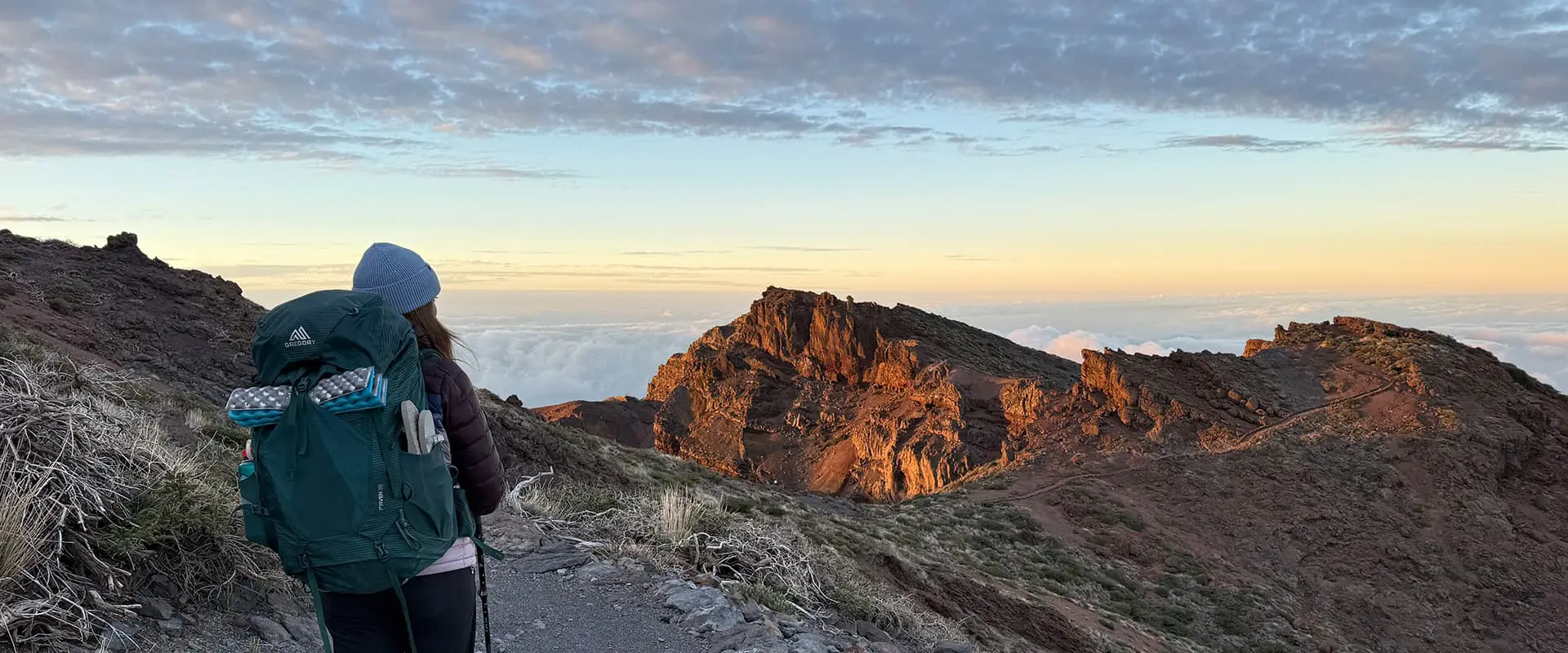
The GR 131 on La Palma is one of the coolest sections of the GR 131. This shorter trail is only three days, but each day you will experience a new part of this island. The first stage climbs up above the clouds and takes you to the famous observatories, where you will have some of the best stargazing in the northern hemisphere. The second stage traces the edge of the Caldera de Taburiente National Park, with lots of views of the ocean on one side and the steep cliffs on the other, and the third stage takes you through the forests and volcanic dunes that make the island so unique.

This trek is a great way to see the island quickly, and there are a few ways you can customize the trail to your liking. Hiking the La Palma section of the GR 131 is an absolute adventure.

women in blue smiling at camera
Editor

Katie Mitchell

After a whirlwind 10 years on the road (and trail!), Katie has hiked the Camino Frances, the Peaks of the Balkans, the Fisherman’s Trail, the Cumbria Way, the Pembrokeshire Way, and more in Europe and the United States. She is an avid trail runner and you can find her either on the trail or in a cafe in a new city, sampling all of their gluten-free treats. You can follow her adventures on Instagram.

View profile

The Trail

Stage one begins at El Time, where you begin hiking from the bus stop. Technically, the stage begins at Puerto de Tazacorte, but the section between there and El Time is currently closed due to landslides. It is easy to take the bus to El Time, where you will be dropped off directly in front of the trailhead. From El Time, which is already at 600 meters, you began immediately climbing uphill. The climb starts by taking you through the outskirts of town. You’ll mostly be on trail, although there are short sections on the road. About a third of the way through the day, you will find a water spigot where you can filter water. The climb is about 1500 meters from El Time, and about 2000 from the actual starting point. This is a day that should not be taken lightly and can be done in 6 to 8 hours.

The stage ends at the Roque de los Muchachos Observatory, where there is a road, so you can arrange a taxi to the closest accommodation. Throughout the stage, you will climb higher and higher, and in doing so, climb above the clouds. Here, the views will change; before where you saw ocean, you are now confronted with a sea of clouds. This is a very special stage, and likely you will see very few people. The observatories located at this point are used by dozens of countries around the world for research, and this is considered one of the best places for astronomical work in the northern hemisphere.

Stage two begins at the observatory, where your taxi will drop you back off. From here, you will hike to El Pilar recreational area, which is a roughly 26-kilometer day. While the climbing is not as strenuous as the day before, you will still have quite a few smaller climbs as you trace the edge of the crater. This is a very beautiful section of the trail if you have clear weather and can see down into the national park. There is an unmanned hut, the Rifugio Punta de los Roques, at the 30-kilometer mark where many people have lunch. This serves as a great halfway point for the day, and some people decide to make the trail into four days and sleep here. There is also portable water, so you can refill.

From the hut, you will begin to hike downhill toward El Pilar, and the weather will start to change as you head into the forest. This is where it gets moodier and cooler, giving you a break from the sun that was likely very strong the days before. There’s also water at the 36-kilometer mark that you can filter, so you don’t need to carry too much when you begin on this day. Soon you will arrive to El Pilar, which is a recreation area in the middle of the forest. There are covered outdoor kitchens, non-potable water spigots, and lots of flat spots to set up your tent.

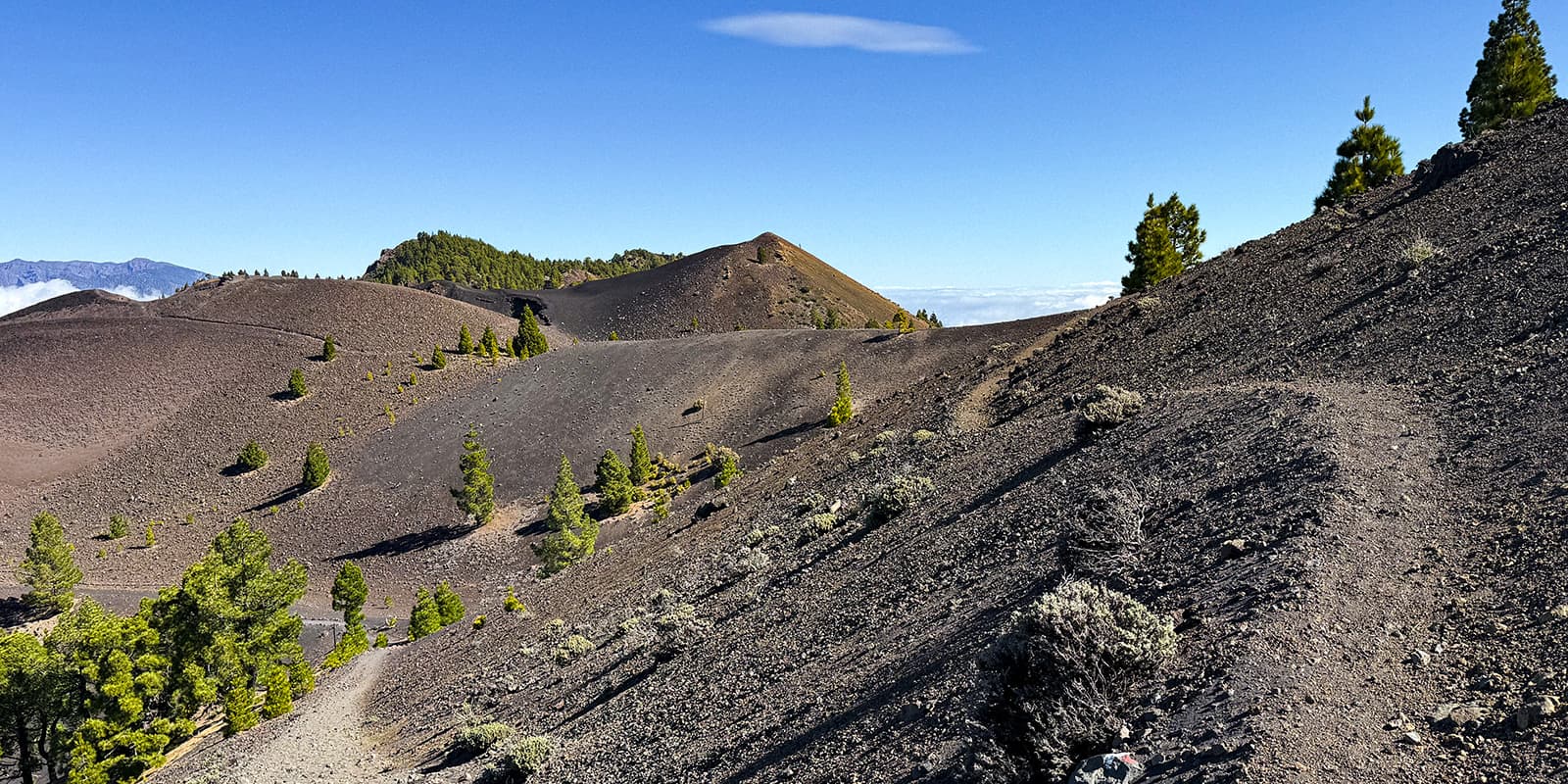
On the final stage, you will leave El Pilar and climb up through the forest in the morning. The climb is gradual and will be a good warm-up. After about an hour and a half, you will emerge above the clouds once again and walk among the volcanoes on the Ruta de los Volcanes. This path will take you between the many volcanoes in the area, where the ground turns into loose, black sand and lava fields. You will hike between the volcanoes, descending on sometimes very steep trail, for about 8 kilometers before the sand dunes turn into forest. Here, you will hike for about 5 kilometers until you reach the town of Los Canarios. There is a Spar in town and some restaurants where you can have a late lunch before the final section of the hike. Once you’re ready, you will hike toward the end point at Faro de Fuencaliente. This section is really unique and you will be back in the lava fields and surrounded by volcanic rock. When you finally reach the coast 6 kilometers later, you will be greeted by a delicious restaurant, beautiful salt flats and a charming red and white striped lighthouse.


Stages

There are only three stages of the GR 131 on La Palma. However, it is common for people to turn this into a four-day trek and split up the second day into two stages, sleeping at the Rifugio Punta de los Muchachos, which is at the halfway point.

Official 3-Day GR 131 La Palma Itinerary

Stage 1:

Puerto de Tazacorte – Roque de los Muchachos, 17 km | 10.5 mi

Stage 2:

Roque de los Muchachos – Refugio de El Pilar,  26 km | 16 mi

Stage 3:

Refugio de El Pilar – Faro de Fuencaliente, 23 km | 14.3 mi

Accommodations

Accommodations on the GR 131 La Palma are varied. The night of the first stage, which ends at the Roque de Los Muchachos, there are no accommodation options. Because of this, you will need to arrange a taxi to pick you up and drive you to one of the nearby hotels, and then drop you off again in the morning. On the second night, there is an official recreation area, El Pilar, where hikers camp. You do not need a reservation. If you wanted to, there is also an unmanned hut, Rifugio Punta de los Roques, around kilometer 30 that you can sleep in. You will not need a reservation for this either. Wild camping is officially illegal on La Palma, like everywhere else in Spain.

Best time of the year

The best time of the year to hike on La Palma is between November and March. This is when the weather is cool enough to safely hike. You will not have crowded trails when you hike, as the majority of the island’s tourists come from the cruise ships and only stay on the coast for day trips. Because of this, the trails remain mostly empty, save for some day hikers on the more accessible sections.

Safety & Gear

While this trail is fairly short, there is still a lot to prepare for hiking on La Palma. You will need to prepare your itinerary and accommodations ahead of time, as this is a difficult one to hike spontaneously. Since there is no food throughout the hike, you will carry all of your meals and snacks for the three days with you. Additionally, you will need to bring all of your camping and cooking supplies for the second night. And finally, you will absolutely need a water filter. There are places to refill, but none of them are treated water, so you will need a filter you trust!

Be aware that the weather changes quite a bit on this trek. In the first stages, when you are above 2000 meters, the weather is usually sunny and can be windy. However, when you descend into the center of the island, it is likely you will come under the cloud cover and have a much colder and wetter experience. Pack clothing for both scenarios to be safe.

The GR 131 is physically demanding, so it is best if you train before hiking it. Working on strength training and balance will help with the climbing, as well as endurance training for the long days and sandy sections. You can do this by taking long hikes at home, grabbing a loaded backpack and trying the stairmaster at the gym, or even going for rocky trail runs to work on your cardio.

Difficulty

The GR 131 La Palma is a difficult trail and should only be attempted if you have successfully hiked a long-distance trail before. It is difficult for a few reasons: the first is the terrain. This is a very steep trail and requires strong physical training beforehand. Even the descent on the final day is steep and you will need a good amount of balance. This, in addition to the usual heat and strong winds, makes it a challenge.

The second reason the GR 131 on La Palma is a difficult hike is because of the logistical arrangements. You will need to sort a hotel and a taxi for the first night/second morning, and carry all of your food for the entire three days. Luckily, there are a few water sources as you hike, but you will need to filter each of these, which can be time-consuming. Because of the camping on the second night, you will also need to carry all of your camping gear in addition to your food, which makes your pack much heavier.

Good to know

There is a small airport on La Palma, but most people fly into Tenerife and take the ferry over. The ferry takes about 3 hours and is easy to book ahead of time online.

The first stage of the trail is only climbing, and while it is a great way to become acquainted with the steepness of the island, it does not (in our opinion) offer the same jaw-dropping beauty or fun as the other stages. Because of this, an alternative could be to begin your hike at the Roque de Los Muchachos, as you have to take a taxi to and from there anyway for accommodations, and to hike from there. If you still want a three-day (or longer) trek, you can add a detour on one of the many other paths that cross the GR 131.

The island is well-routed with buses, even in the more remote southern region. You can take a bus from the end point back up to Los Canarios and then from there to wherever you need to go. However, be warned that the buses only go every few hours from Fuencaliente, and thus you may need to time your hiking to be sure to arrive in time. There are no accommodations at the endpoint.

Because you cannot fly with camping gas/propane, you will need to buy it on the island. In Santa Cruz de la Palma, there is a running shop that sells it called Riverol Running. They also have a few other basic things in case you need them.

Route
point-to-point
highest point
2400m (7874 ft)

Want to submit a trail or make this page more complete?

Always read the disclaimer

Terms of Use: important to all visitors on this website. We strive to publish high quality content and information on this website. However it’s always possible that we’re missing out on some crucial information. In spite of the fact that this route, associated GPS track (GPX and maps) were prepared under diligent research by the specified contributor and/or contributors, the accuracy of such and judgement of the author is not guaranteed. Therefore, hiking-trails.com and contributors are in no way liable for personal injury, damage to personal property, or any other such situation that might happen to individuals hiking or following this route. Should you choose to hike this trail, this is always at your own risk. Check out our guidelines for safety hiking and Leave No Trace principles at the hiking 101 page.

Download GPX

Join the community!

Login or create a FREE account 😊

With an account you can:

Download GPX files

Pin trails to your wishlist

Mark trails as hiked by you

Rate hiking trails

Comment on trails, blogs and gear reviews

Happy trails!
Login

Don't have an account yet? Register here