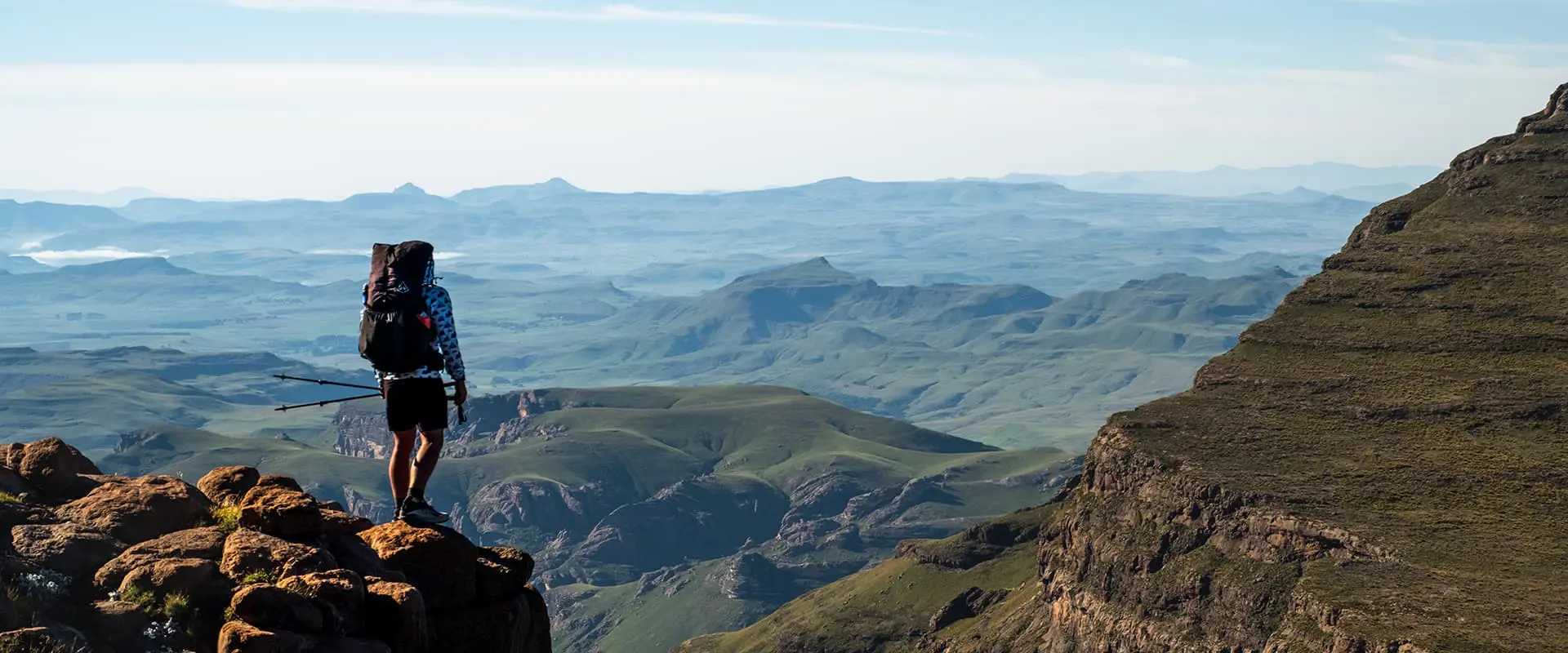
Hiking NOBO, the first stage of the trail begins at the lowest point in the range, Bushman’s Nek. There, you will pay 1 day of hiking fees (be sure not to pay for the full hike, as they do not have jurisdiction for the whole trail, but will happily take your money). The trail rapidly ascends the Drakensberg on a good trail. At the top, the trail vanishes, and the only trails encountered from this point are sheep paths. From the top of the Nek to Sani is a section with many, many Basotho Shepherds, and camping locations need to be carefully thought out.
Sani can be passed at the border control on the escarpment, or if you follow the inland route (it’s better), you will cross the Chinese-built tar road roughly 5 kilometers inland. For hikers doing the trail in 14 days, it’s advised to get food delivered to this point.
From Sani, the route passes over one big pass before climbing to the peak of the tallest mountain south of Kilimanjaro, Thabana Nhlenyana. There is a steep descent down the northern side and into a valley, which you will follow all the way to Giants Pass. This is a good bail point as it is just 17 kilometers down the pass to the nearest hotel (and buffet). However, it is very important that you do not camp on the Nursery Slopes or anywhere near the Giants Pass or Giants Castle. This area is notorious for cattle and drug smuggling as well as gale-force winds that regularly destroy tents.
Section 3 heads northward over a pass into the next valley. Camping can be found at the bottom, with two options for the next ~30 kilometers. 1: You can leave the escarpment and follow the river inland until returning to the escarpment near Mafadi Peak. This is longer but with fewer passes. 2: The escarpment can be followed over 3 passes. It’s a steep day, but the views are worth it when it’s clear. The route passes over Mafadi and down Ship’s Prow Pass, over another steep pass, and then along the longest “flat” section of trail to a beautiful valley full of swimming holes. The final section of this stage takes hikers up and over to Organ Pipes Pass, another good route for an emergency evacuation, as well as the second refuel point for hikers taking it slowly.