Het Ziltepad: Walking the salt-worn edge of the North
Publication date: 19 Jun 2026
InspirationTrails
Coastal dunes until the horizon, old forts, lighthouse-boats to guide the sailors of old, Het Ziltepadhas it all. One moment you are surrounded by lush vegetation at the edge of the dunes, another moment you’ll only hear the wind and you’ll see almost nothing around you except for a big open sky. The ‘Kop van Noord Holland’ is an interesting place with lots of history. We spent four days out here walking a brand-new stretch of Het Ziltepad, one of the country’s long-distance trails.
The name translates roughly to “the salty path,” and it earns it. The full route runs 440 kilometers across 22 stages, threading its way along the Wadden coast of North Holland, Friesland, and Groningen, from Den Helder all the way to Termunten. It’s a trail that moves from church to church, through a large variety of historical places and landscapes. This past April, the route was extended into the Kop van Noord-Holland — the very top of the province — with a new starting point at the Nieuwe Kerk in Den Helder.
Chris König
Chris works as an outdoor photographer and can regularly be found in nature with his camera and tent: the higher the mountain, the better. He is always on the lookout for the balance between real emotion, atmosphere, and lively action. Next to his passion for photography, he organizes workshops in countries such as Iceland, Kyrgyzstan and Greenland.
Chris is also active as a travel and photojournalist for various media, including Columbus Magazine, NatGeo Traveler, Lonely Planet NL and the NKBV.
We began where Het Ziltepad now begins, at the Nieuwe Kerk in Den Helder. Tjitske, one of the volunteers who keep these churches open for hikers, met us at the door. There’s something about being welcomed into a place by someone who genuinely loves it, and that set the tone for the whole trip. The little detail she shared has stuck with us: the Nieuwe Kerk was never bombed during the war, while so much of Den Helder around it was flattened. It still stands as it always has; quite the miracle if you asked her.
From there, Paul took us through Willemsoord, the old naval shipyard, and the maritime history came pouring out. We learned about Dorus Rijkers, one of the most famous lifeboatmen in Dutch history, a man who, as skipper of the Den Helder lifeboat, helped pull roughly 500 people from the brutal waters of the Marsdiep. By 1926 he was said to be the most popular man in the entire country. We also got to see how the old rescues worked: a wippertoestel, a contraption that fired a line out to a stranded ship with something like a small cannon, after which shipwrecked sailors were hauled back to shore in a kind of breeches harness sliding along the rope. And Paul pointed out a spot on Willemsoord with the wonderfully bleak name Boerenverdriet — “farmers’ sorrow” — because when a ship lay in the harbor, salt water would sometimes wash into the freshwater canal and ruin the farmers’ crops.
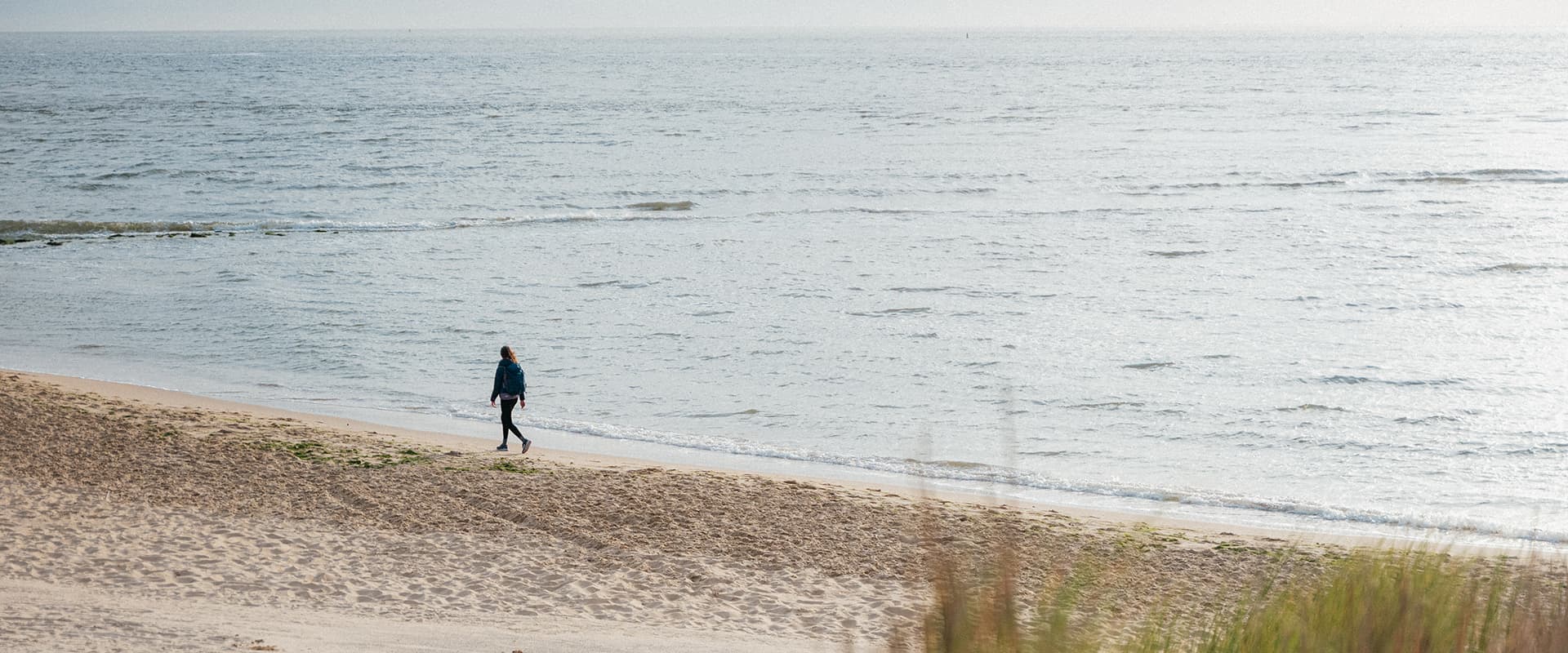
After lunch at restaurant Stoom, we set off on the first leg proper: the 13.6 kilometers from Den Helder to Huisduinen.
To Huisduinen and the start of the Wadden Sea
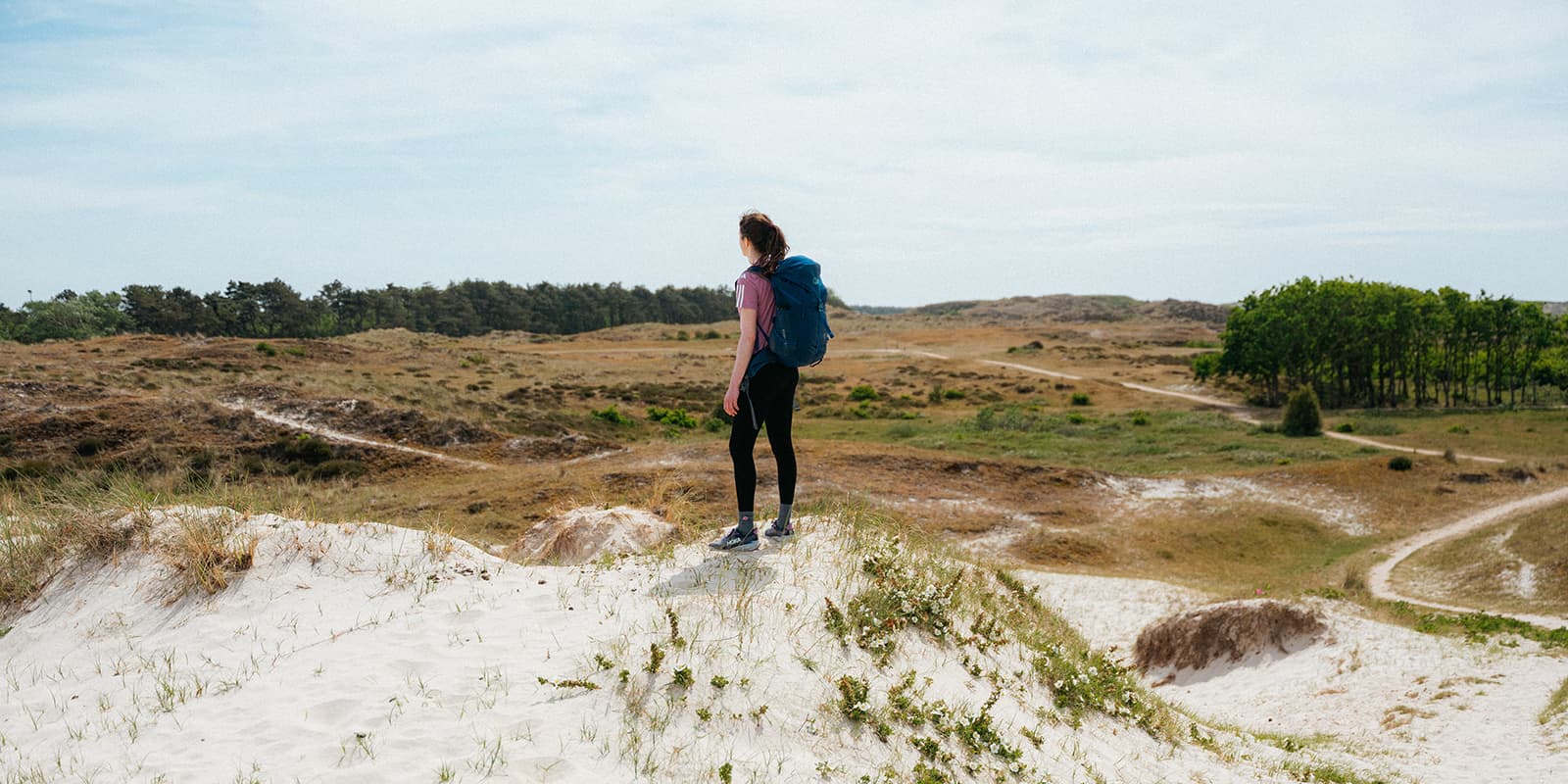
The walk out to Huisduinen is where the landscape really opens up with the beautiful dunes and sight of the sea in the distance. Jan was waiting for us at the little Huisduinerkerkje, another volunteer with countless stories which really showed the passion these people have for both their town and its history.
We checked into the Fortwachterswoning, the fort-keeper’s house at Fort Kijkduin, and this turned out to be one of the highlights of the entire trip. If you stay the night here, you get the sunset over the sea more or less to yourself. We stood on the old fort with the light going gold and then pink over the water, and it felt like the whole coast had been handed to us for the evening. Dinner that night was at Nogal Wiedus, just down the road.
Into the polder: Huisduinen to Anna Paulowna
The next day took us inland, away from the dunes and into the wide agricultural polder. We stopped for lunch at Zee van Tijd in Julianadorp, where, as it happens, there’s a sand sculpture on display (the area hosts a sand-sculpture festival), a fun bit of unexpected art in the middle of a walking day.
By late afternoon we reached Anna Paulowna, with another church as the endpoint for that day’s walk. Anneke welcomed us for the night at B&B de Waard. A traditional farm, but completely renovated. This is the heart of what makes Het Ziltepad special: it isn’t just a route across a landscape, but it is that combination of interactions, staying in various authentic places and getting to know the history of a place through the stories people tell you.
A food forest and a night in a yurt
Our final full day ran from Anna Paulowna toward Wieringerwaard, ending at Johanna’s Bos. We are welcomed by Tine on their farm. That is, the place looks like a farm when you see it from a distance, but later you see it for what it really is: a place where people get together. Theatre shows are organized in the farm theatre and a food forest is growing with a large variety of edible plants and vegetables. When Tine started this place, it was an old farm with nothing there yet. Now everything changed and the place definitely inspired us.
For the night we stay in a yurt and we cook our dinner on the campfire. What more do you want? On their websiteyou’ll find more information and you can even come visit with your own campervan.
Why walk the Kop van Noord-Holland
You don’t have to commit to all 440 kilometers to fall for Het Ziltepad. The new stages in the Kop van Noord-Holland are easy to walk as a standalone stretch. The towns are well-connected by train, and the daily distances (mostly 15–25 km) are gentle enough to leave room for the churches, lunches, and conversations along the way.
What we’ll remember most isn’t the scenery (although not many things beat the sunset over the sea from the roof of Fort Kijkduin), it’s the people. The volunteers with their enthusiasm, the hosts of the various accommodations, the locals with their interesting stories.
Het Ziltepadis a joint initiative of the Groninger Kerken and Stichting Alde Fryske Tsjerken, in partnership with Visit Wadden. More info at Visit Wadden.



 Starting at the edge: Den Helder
 From there, Paul took us through Willemsoord, the old naval shipyard, and the maritime history came pouring out. We learned about Dorus Rijkers, one of the most famous lifeboatmen in Dutch history, a man who, as skipper of the Den Helder lifeboat, helped pull roughly 500 people from the brutal waters of the Marsdiep. By 1926 he was said to be the most popular man in the entire country. We also got to see how the old rescues worked: a wippertoestel, a contraption that fired a line out to a stranded ship with something like a small cannon, after which shipwrecked sailors were hauled back to shore in a kind of breeches harness sliding along the rope. And Paul pointed out a spot on Willemsoord with the wonderfully bleak name Boerenverdriet — “farmers’ sorrow” — because when a ship lay in the harbor, salt water would sometimes wash into the freshwater canal and ruin the farmers’ crops.
 To Huisduinen and the start of the Wadden Sea
 Into the polder: Huisduinen to Anna Paulowna
 A food forest and a night in a yurt
 Why walk the Kop van Noord-Holland